
Michigan Retaliation Attorneys: Your Shield Against Employer Payback

When to Call a Retaliation Attorney in Michigan
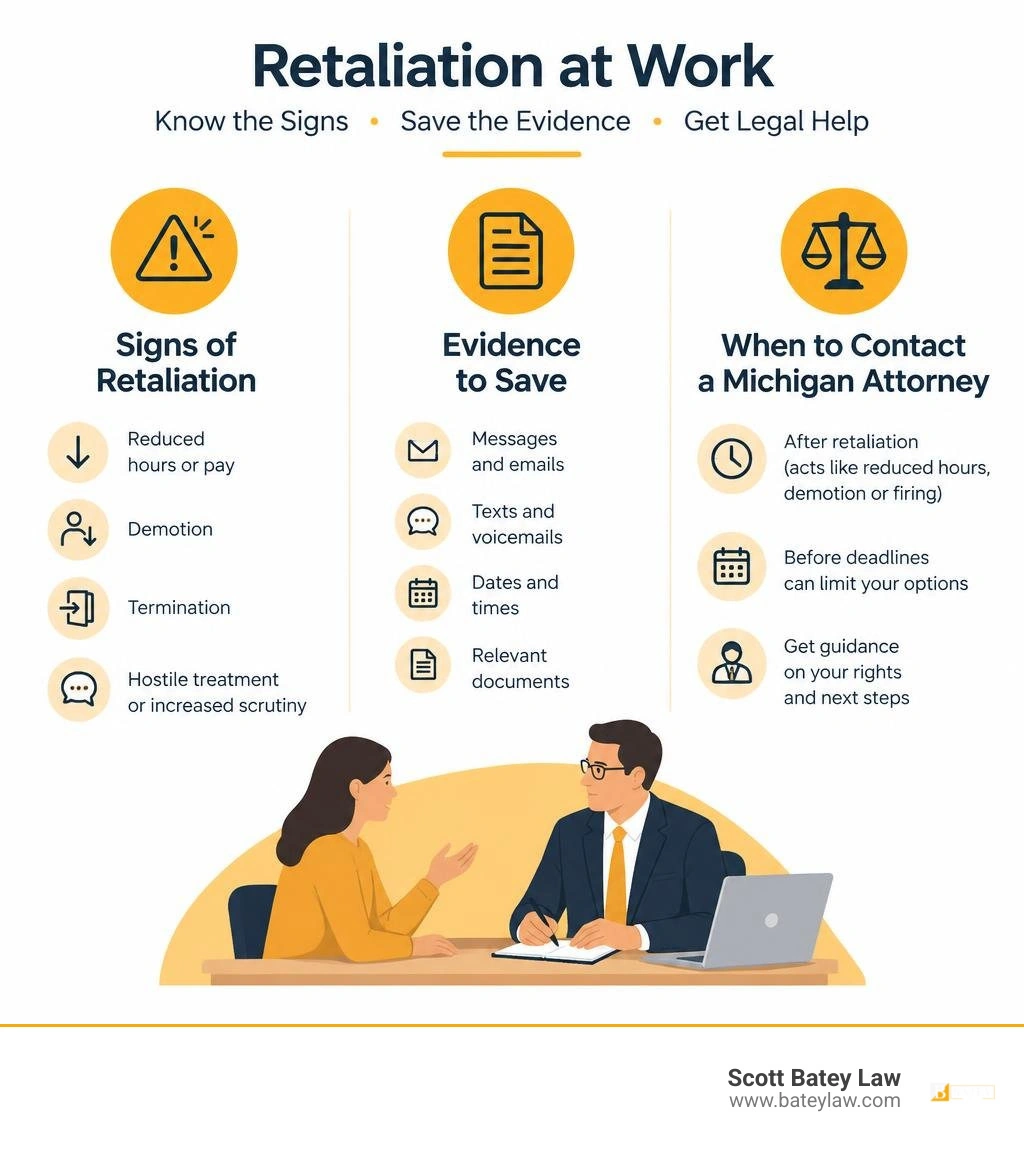
If your employer cut your hours, demoted you, or fired you after you reported harassment or exercised a workplace right, a retaliation attorney in Michigan can help assess your options. Save relevant messages, write down what happened and when, and seek legal advice promptly. Filing deadlines can be short.
I'm Scott Batey, and if your search for retaliation attorney michigan brought you here, I've represented Michigan employees in retaliation and other workplace disputes since 1996. Recognized by Michigan Super Lawyers each year since 2014, I help workers identify the evidence that matters and decide what to do next.
Retaliation attorney michigan terms at a glance:
- fmla retaliation michigan
- workplace retaliation michigan
- how long do i have to report retaliation in michigan
Introduction

Workplace retaliation happens when an employer punishes an employee for exercising their legally protected rights. While many workers assume that being an "at-will" employee means management can fire or penalize them for any reason at all, state and federal laws place strict boundaries on employer conduct. You cannot be punished simply for doing what the law protects you to do.
Unfortunately, employer retribution remains widespread. Retaliation charges filed with the Equal Employment Opportunity Commission (EEOC) consistently represent the single most common workplace complaint, accounting for over 55% of all charges filed nationwide. In fiscal year 2022 alone, the EEOC received more than 45,000 retaliation charges across the country, with Michigan workers submitting over 1,000 retaliation claims.
When management strikes back because you spoke up, you do not have to absorb the fallout alone. Understanding your statutory protections allows you to stand your ground and pursue full financial recovery.
Understanding Workplace Retaliation Under Michigan and Federal Law
To build a solid claim, it helps to understand what the law actually forbids. At both the state and federal levels, anti-retaliation provisions protect workers who oppose unlawful practices or participate in legal investigations. Under federal law, statutes such as Title VII of the Civil Rights Act of 1964 shield employees from adverse actions when they challenge discrimination based on race, color, religion, sex, or national origin.
In Michigan, state laws offer parallel and sometimes broader protections. The Elliott-Larsen Civil Rights Act (ELCRA) prohibits retaliation against individuals who oppose discriminatory employment practices or file complaints. Simultaneously, the Michigan Whistleblowers' Protection Act (WPA) provides targeted protection for workers who report, or are about to report, a suspected violation of local, state, or federal law to a public body. For a comprehensive overview of how state statutes interact, review our Workplace Retaliation Michigan Guide 2026.
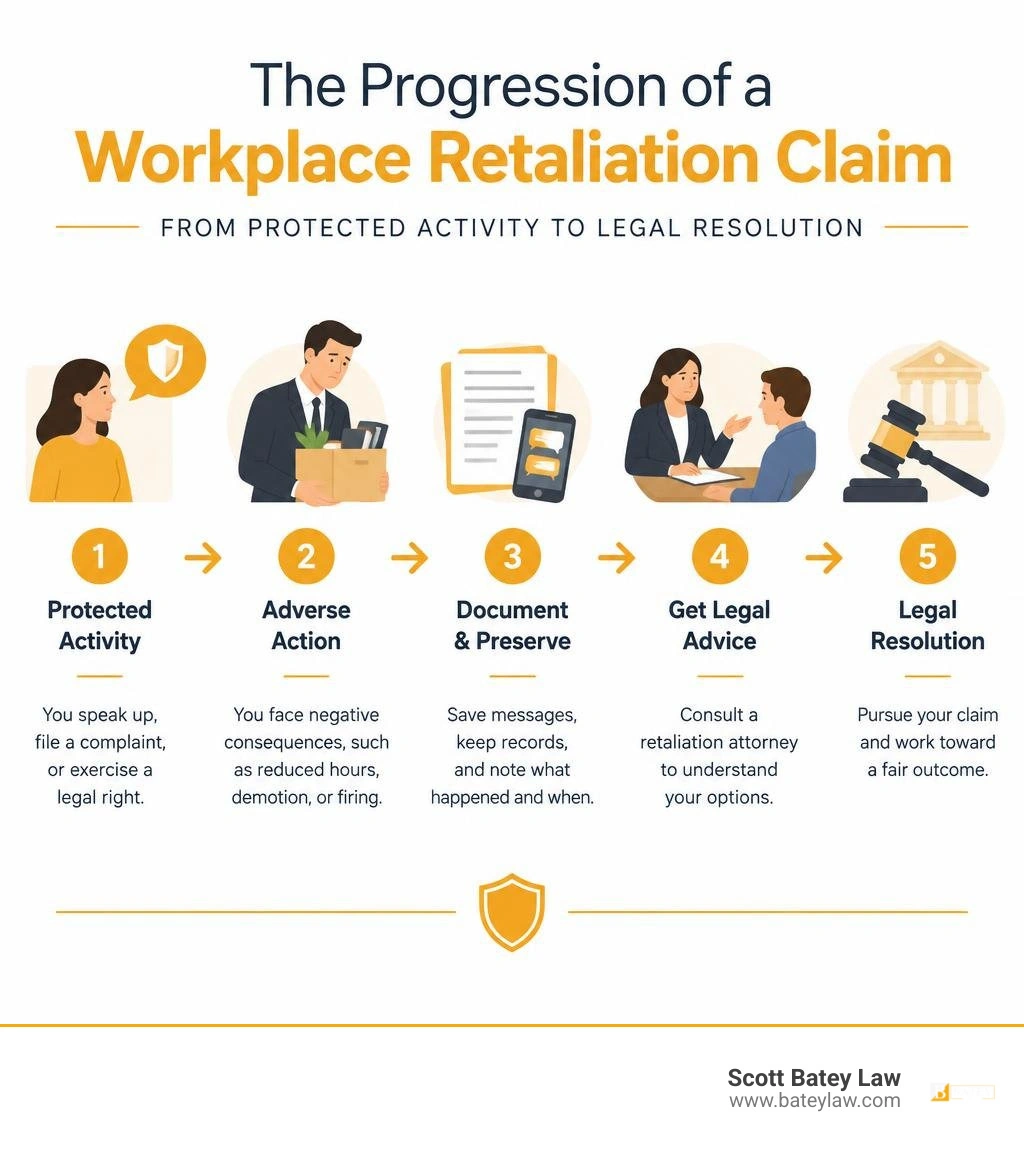
Establishing employer liability requires establishing three core elements:
- You engaged in a legally protected activity.
- Your employer took a materially adverse employment action against you.
- A causal connection existed between your protected activity and the adverse action.
Meeting this burden of proof requires demonstrating that the employer's adverse move was driven by retaliatory intent rather than legitimate performance concerns.
| Feature / Standard | Michigan Whistleblowers' Protection Act (WPA) | Elliott-Larsen Civil Rights Act (ELCRA) |
|---|---|---|
| Protected Activity | Reporting or preparing to report a legal violation to a public body | Opposing illegal discrimination, harassment, or participating in an investigation |
| Statute of Limitations | Strict 90-day deadline from the retaliatory act | Generally 3 years to file a lawsuit in state circuit court |
| Exhaustion Requirement | No administrative exhaustion needed; direct court filing | Direct court filing or optional administrative complaint with MDCR/EEOC |
| Primary Focus | Public interest, safety, regulatory compliance, and statutory breaches | Civil rights, equal opportunity, freedom from bias and harassment |
Common Forms of Retaliation in the Workplace
Adverse actions are not always as straightforward as an immediate termination letter. Employers frequently use subtle, escalating tactics designed to make your work life miserable enough to force a resignation.
Common retaliatory actions include:
- Wrongful Termination: Finding yourself abruptly fired after reporting harassment or discriminatory behavior.
- Sudden Demotions and Pay Cuts: Stripping away managerial responsibilities, reassigning titles, or reducing hourly rates and bonuses.
- Hostile Scheduling: Shifting an employee to undesirable night shifts, cutting hours to starve them financially, or canceling flexible arrangements.
- Safety Complaint Backlash: Facing disciplinary action, harassment, or dismissal after an incident involving retaliation after reporting a safety issue to MIOSHA or internal safety boards.
- Manufactured Paper Trails: Receiving sudden negative performance reviews, unwarranted written warnings, or sudden micromanagement after years of glowing evaluations.
- Workplace Isolation: Excluding you from crucial department meetings, strategic emails, and professional development opportunities.
Protected Activities That Shield Michigan Workers
An action only qualifies as illegal retaliation if the initial step you took is considered a "protected activity" under the law.

These protected activities encompass a wide range of employee actions:
- Civil Rights Filings: Submitting internal complaints or formally pursuing EEOC retaliation claims in Michigan regarding workplace discrimination or sexual harassment.
- Wage and Hour Disputes: Challenging unpaid overtime, misclassification, or minimum wage violations, including asserting your rights against retaliation for wage complaint in Oakland County and across Southeast Michigan.
- Taking Medical Leave: Exercising your statutory leave rights under the Family and Medical Leave Act without facing FMLA retaliation in Michigan.
- Requesting Accommodations: Seeking reasonable workplace changes for disabilities under the Americans with Disabilities Act or Michigan's Persons with Disabilities Civil Rights Act, where ADA and PWDCRA retaliation claims protect your right to work without penalty.
Why You Need a Dedicated Retaliation Attorney in Michigan
Employment litigation involves complex procedural rules, strict timelines, and aggressive corporate defense tactics. Companies routinely hire skilled defense counsel whose sole mission is to minimize payouts and get claims dismissed. Hiring a dedicated employment attorney ensures you have a seasoned advocate who knows the playbook inside and out.
General practice attorneys may handle an occasional employment matter, but specialized employment practitioners possess direct experience with local courts, evidentiary standards, and judge tendencies in Southeast Michigan. We bring the trial readiness and negotiation leverage needed to hold recalcitrant employers accountable.
How a Retaliation Attorney in Michigan Proves Adverse Employment Actions
Proving retaliation rarely involves a supervisor stating, "I am firing you because you complained." Instead, employers offer fabricated explanations—known in legal terms as pretext.
To establish liability, we deploy proven evidentiary strategies:
- Temporal Proximity: Demonstrating that the adverse action occurred very shortly after you spoke up or filed a complaint.
- Direct and Circumstantial Evidence: Uncovering emails, text messages, or verbal statements showing management's frustration with your report.
- Pretextual Discipline: Revealing how company policies were selectively enforced against you while coworkers engaging in the exact same conduct faced zero consequences.
- Witness Testimony: Gathering statements from coworkers that expose sudden shifts in managerial demeanor after you asserted your rights, consistent with guidance on handling retaliation after speaking up in Michigan workplaces.
What to Expect During a Free Consultation with a Retaliation Attorney in Michigan
Reaching out for legal help should not feel intimidating. During an initial consultation, we focus on establishing clarity:
- Merits Evaluation: We analyze whether your actions qualify as protected activity and if the employer's response meets the legal standard for an adverse action.
- Timeline and Record Review: We look over your performance history, communication logs, and termination or disciplinary documents.
- Strategic Roadmap: We outline available administrative and judicial avenues, whether through the EEOC, Michigan Department of Civil Rights (MDCR), or direct court litigation.
- Clear Fee Structures: We explain contingency fee arrangements, meaning you pay no upfront legal fees unless financial recovery is secured on your behalf.
Steps to Take If You Experience Workplace Retaliation in Michigan
If you suspect management is laying the groundwork to push you out or penalize you, the actions you take immediately will shape your legal claim.
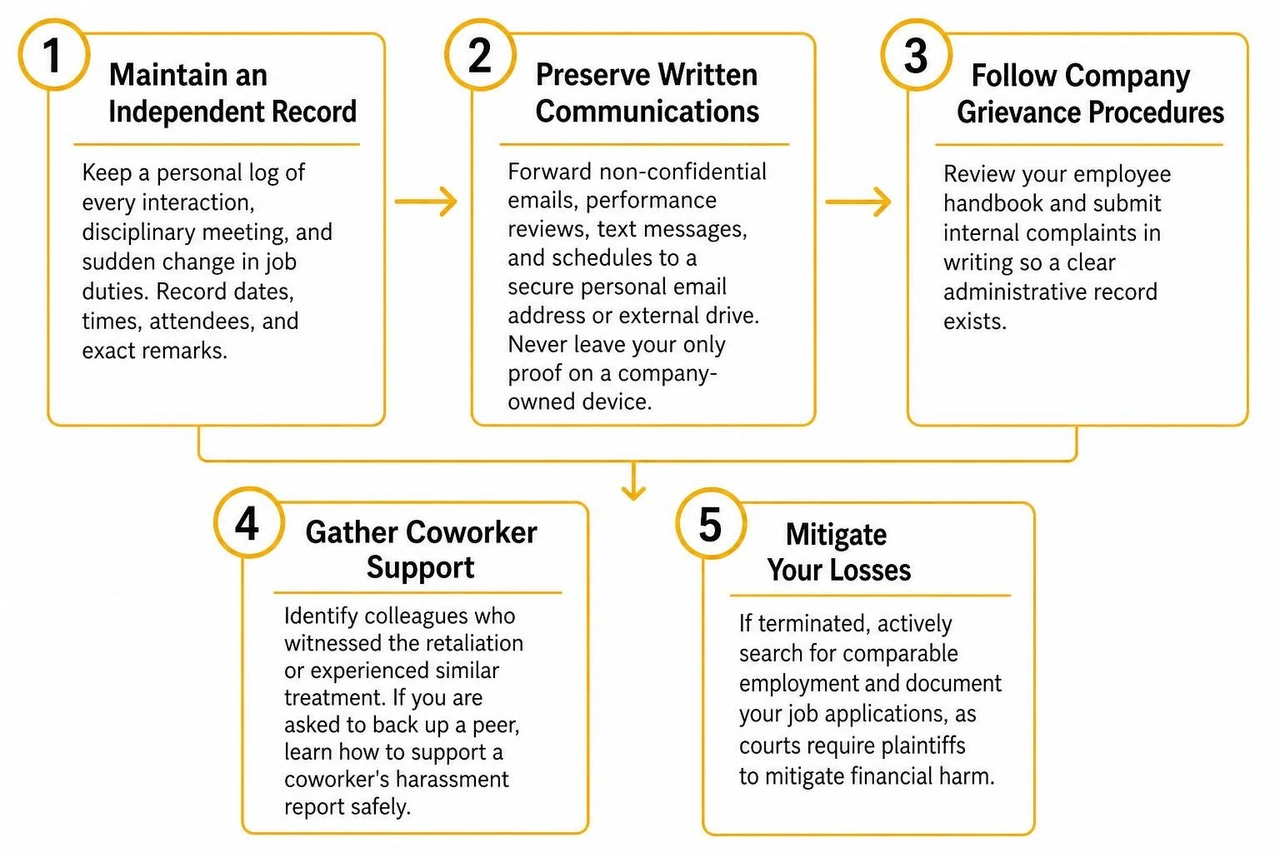
- Maintain an Independent Record: Keep a personal log of every interaction, disciplinary meeting, and sudden change in job duties. Record dates, times, attendees, and exact remarks.
- Preserve Written Communications: Forward non-confidential emails, performance reviews, text messages, and schedules to a secure personal email address or external drive. Never leave your only proof on a company-owned device.
- Follow Company Grievance Procedures: Review your employee handbook and submit internal complaints in writing so a clear administrative record exists.
- Gather Coworker Support: Identify colleagues who witnessed the retaliation or experienced similar treatment. If you are asked to back up a peer, learn how to support a coworker's harassment report safely.
- Mitigate Your Losses: If terminated, actively search for comparable employment and document your job applications, as courts require plaintiffs to mitigate financial harm.
Michigan Filing Deadlines and the Legal Process
Missing a legal deadline will permanently extinguish an otherwise valid claim. Knowing your applicable statutes of limitations is critical:
- Whistleblowers' Protection Act (WPA): Michigan enforces a strict 90-day deadline from the date of the retaliatory act to file a complaint in circuit court. For detailed statutory timelines, review our guide on WPA deadlines and remedies in Michigan.
- EEOC and Title VII / ADA: You have 300 days in Michigan to submit a formal charge of discrimination with the EEOC before you can obtain a right-to-sue letter.
- Elliott-Larsen Civil Rights Act: Claims brought directly under the ELCRA generally carry a 3-year statute of limitations.
To ensure your filing remains timely, review our breakdown on how long to report retaliation in Michigan.
Available Damages and Financial Compensation in Retaliation Cases
Victims of retaliation can recover significant remedies under state and federal law. While outcomes vary based on wage history and case severity, average monetary benefits through EEOC conciliation and litigation often range from $10,000 to over $100,000, with substantial trial verdicts climbing higher.
Potential remedies include:
- Back Pay: Total lost wages, overtime, and benefits from the date of the adverse action up to the resolution of the case.
- Front Pay: Anticipated future wage losses if returning to the job is impossible due to workplace hostility.
- Emotional Distress and Exemplary Damages: Compensation for anxiety, depression, reputational harm, and mental anguish caused by employer payback.
- Punitive Damages: Monetary penalties assessed under federal statutes to punish particularly egregious employer misconduct.
- Attorney Fees and Litigation Costs: Reimbursement for the legal expenses required to prosecute your claim.
- Job Reinstatement: Court orders requiring the company to restore your previous position, seniority, and benefits.
Frequently Asked Questions About Michigan Retaliation Claims
What is the difference between retaliation, discrimination, and wrongful termination?
These claims often overlap, but their legal triggers differ:
- Discrimination focuses on mistreatment rooted in protected traits (such as race, sex, age, disability, or religion).
- Retaliation targets punishment triggered by an action you took (such as reporting illegal conduct or requesting FMLA leave).
- Wrongful Termination is an overarching term covering any firing that violates state statutes, federal employment laws, employment contracts, or public policy.
Can my employer fire me immediately after I report illegal activity?
While Michigan is an at-will employment state, at-will rules never shield illegal conduct. Under the Michigan Whistleblowers' Protection Act, terminating an employee because they reported or were about to report a suspected violation of law to a public authority is unlawful.
When an employer creates a false narrative to justify an immediate firing, courts use established frameworks to examine whether the timing and shifting explanations prove unlawful pretext.
What geographic areas in Michigan do retaliation attorneys cover?
From our primary office in Bingham Farms, we represent employees across Oakland County, Wayne County, and throughout Southeast Michigan, including Southfield, Birmingham, Detroit, Troy, Royal Oak, Beverly Hills, Farmington Hills, Oak Park, Ferndale, Berkley, and Madison Heights.
Conclusion
When your career, livelihood, and professional reputation are threatened because you had the integrity to speak up, taking decisive action is essential. For over 25 years since 1996, Scott Batey has championed the rights of employees facing illegal workplace retaliation across Michigan. Recognized consistently by Michigan Super Lawyers since 2014, our firm delivers personalized, aggressive advocacy designed to hold employers accountable and secure the compensation you deserve.
If you are facing adverse employment actions after reporting misconduct, do not wait for the situation to worsen or let critical statutory deadlines pass. Connect with an experienced retaliation lawyer at Batey Law Firm PLLC today to schedule a confidential consultation and start protecting your future.