
Michigan Workplace Break Compliance for Restaurant and Salaried Workers

Michigan Lunch Break Rules for Exempt Employees
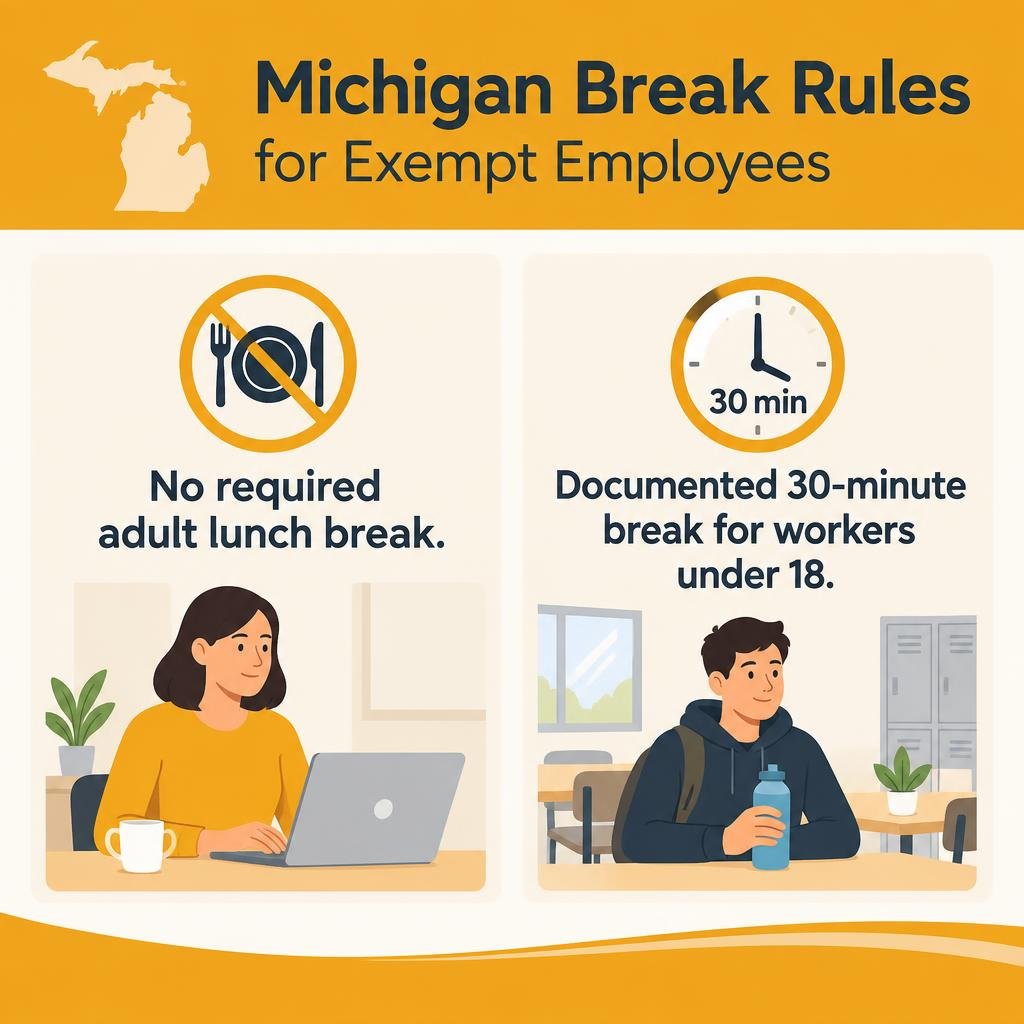
Michigan does not require meal or rest breaks for employees age 18 or older. That rule applies to overtime-exempt employees and non-exempt workers alike, including restaurant staff. Employees under 18, however, cannot work more than five hours without a documented, uninterrupted 30-minute break.
A salary does not, by itself, make someone overtime-exempt. And even when an adult lunch break is optional, pay rules still matter: non-exempt employees must be paid for time spent working through lunch, while exempt employees generally must receive their full salary for a week in which they work. Nursing breaks, disability accommodations, and workplace policies may also give employees rights beyond Michigan's general break rule.
I'm Scott Batey, a Michigan employment lawyer who has represented workers in pay and workplace disputes since 1996. I advise workers across the state regarding workplace rights, including Michigan lunch break exempt employees facing improper job classifications or unlawful pay deductions.
Understanding Michigan Lunch Break Exempt Employees Under State and Federal Law
Many employees across Michigan assume the law guarantees every worker a dedicated midday meal break. However, navigating employee break laws in michigan requires understanding that neither Michigan state law nor the federal Fair Labor Standards Act (FLSA) requires employers to offer meal or rest periods to adult personnel.
When discussing exemptions in this context, confusion often arises. In wage and hour law, "exempt" typically refers to workers who are exempt from statutory overtime pay requirements. Because Michigan law does not mandate meal breaks for any adult worker, both exempt and non-exempt adults share the same statutory baseline regarding break mandates: employers are not legally obligated to provide them. For Michigan lunch break exempt employees, the key distinction is not whether a break is required, but how break time affects pay and salary protections.

However, how meal breaks affect pay is where classification becomes critical. Salaried exempt workers are paid a predetermined salary to get a job done, regardless of how many hours they log or whether they step away to eat. In contrast, non-exempt workers are paid strictly for the hours they work, making precise time tracking of breaks essential.
Salary and Duty Thresholds for Michigan Lunch Break Exempt Employees
To be properly classified as exempt from overtime under state and federal frameworks, an employee must satisfy specific statutory criteria involving both salary level and job duties. Under Michigan's IMPROVED WORKFORCE OPPORTUNITY WAGE ACT (EXCERPT) alongside federal regulations, exemption relies on three main white-collar categories:
- Executive Exemption: The worker's primary duty must be management of the enterprise or a recognized department. They must regularly direct the work of two or more full-time staff and possess the authority to hire or fire (or have significant weight given to their recommendations).
- Administrative Exemption: The employee's primary role must involve non-manual office work directly related to management or general business operations, requiring the regular exercise of discretion and independent judgment on significant matters.
- Professional Exemption: The primary duty must require advanced knowledge in a specialized field of science or learning acquired through prolonged intellectual instruction, or work requiring invention, imagination, or talent in a recognized artistic field.
Simply giving a restaurant shift supervisor or office worker a "manager" title does not make them exempt. If their primary duties involve manual labor, preparing food, running cash registers, or following rigid routines without independent discretion, they are legally non-exempt, regardless of how their compensation is structured.
FLSA Baseline vs. State Wage Regulations
Federal law establishes the baseline for wage and hour enforcement across the United States, and Michigan law aligns closely with these federal principles. If an employer chooses to provide breaks, federal FLSA standards govern how that time must be compensated.
| Provision | Salaried Exempt Employees | Non-Exempt Hourly Employees |
|---|---|---|
| Mandatory Adult Lunch Breaks | None under state or federal law | None under state or federal law |
| Short Rest Breaks (5–20 Mins) | Paid (included in fixed salary) | Paid as compensable work time |
| Meal Periods (30+ Mins) | Paid (full salary remains unchanged) | Unpaid only if completely relieved of duty |
| Working Through Lunch | Salary cannot be reduced | Must be fully compensated for all time |
| Timecard Break Logging | Not required for pay calculation | Mandatory under state record-keeping rules |
For non-exempt employees, a meal break can only be unpaid if it is a bona fide meal period. Under the law, this means the worker must be completely relieved from duty for at least 30 consecutive minutes. If a receptionist must answer phones while eating at their desk, or a restaurant cook must watch the fryers while eating a sandwich, they are not completely relieved. That time remains compensable work time. For exempt workers, taking or skipping lunch does not alter their weekly salary.
Meal and Rest Break Obligations Across Job Classifications
Workplace policies often create contractual expectations, even where statutes do not mandate rest periods. Understanding employment law breaks at work helps both businesses and staff navigate what is legally required versus what is provided by company policy.
Because adult meal breaks are discretionary under Michigan law, employers have wide latitude to structure workplace schedules. An employer can offer a 30-minute unpaid lunch, two 15-minute paid breaks, or no breaks at all during an eight-hour shift for adult staff. However, once an employer establishes a policy or practice, it must comply with statutory pay regulations.
Non-Exempt Hourly Workers vs. Salaried Roles
For hourly staff, short rest periods ranging from 5 to 20 minutes are considered compensable work time under federal rules. Employers cannot require workers to clock out for brief coffee breaks or bathroom visits. Our firm regularly reviews paid breaks for hourly employees to identify improper wage deductions.
Workers frequently ask are 15 minute breaks required by law in michigan, and the answer remains no—there is no statutory obligation to provide them. But if an employer allows short 15-minute breaks, that time must be paid.
In contrast, salaried exempt workers do not track short breaks. Their pay is not tied to hours or minutes logged, meaning brief pauses throughout the workday have no impact on their compensation.
Mandatory Protections for Minor Employees Under YESA
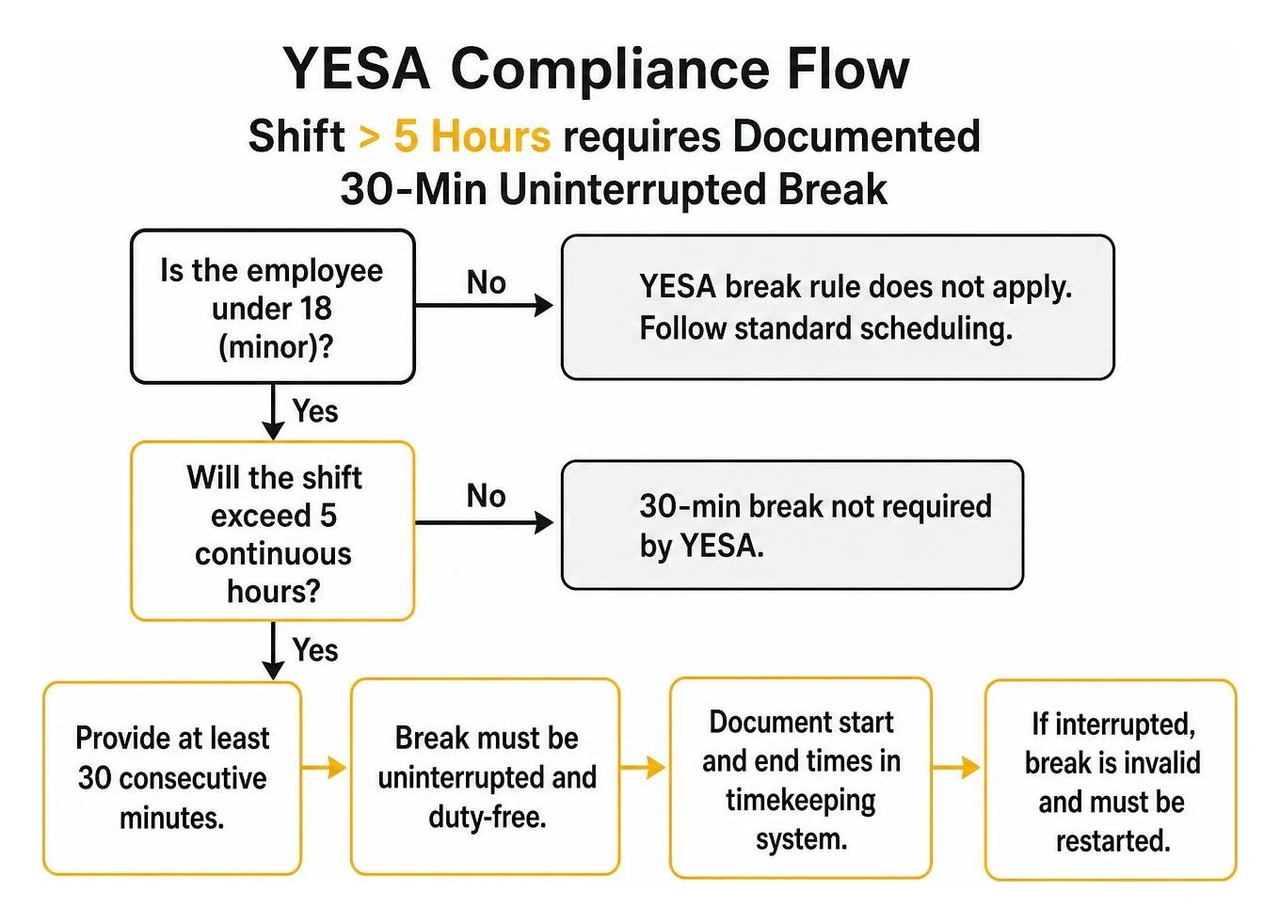
The major exception to Michigan's permissive break rules involves minors. Under Michigan's Youth Employment Standards Act (YESA), employees under 18 years of age are legally protected by mandatory break requirements:
- The Five-Hour Rule: A minor cannot work more than five continuous hours without an uninterrupted rest period.
- Duration: The break must be at least 30 continuous minutes.
- Documentation: Employers must explicitly document the start and end times of minor meal periods in their timekeeping systems.
- Duty-Free Requirement: The minor must be completely relieved of all work responsibilities. If interrupted to handle a task, the break is invalid and must be restarted.
Employers in hospitality, retail, and seasonal industries face significant regulatory scrutiny regarding youth labor. Failing to schedule and record these mandatory breaks can result in administrative sanctions and civil penalties.
Federal Accommodations and Industry-Specific Exceptions
While state break laws for adults are minimal, federal statutes establish specific break obligations for protected employee groups. Furthermore, workers wondering how many breaks in a 12 hour shift by law must consider how extended shifts interact with federal accommodation mandates.

PUMP Act and ADA Workplace Break Mandates
Federal legislation creates mandatory break rights that override general state-level silence on adult rest periods:
- The Providing Urgent Maternal Protections (PUMP) for Nursing Mothers Act: Requires employers to provide reasonable break time for an employee to express breast milk for one year after the child's birth. Employers must provide a private space (other than a bathroom) shielded from view and free from intrusion. For exempt employees, their salary cannot be docked for taking lactation breaks. For non-exempt employees, the time may be unpaid unless the worker is not completely relieved of duties or takes the break during an otherwise paid rest period.
- Americans with Disabilities Act (ADA): An employee with a documented medical condition (such as diabetes, back injuries, or autoimmune disorders) may request modified break schedules as a reasonable accommodation. Employers must engage in an interactive process to accommodate these medical needs unless doing so creates an undue hardship.
Restaurant and Healthcare Shift Dynamics
Certain industries operate under unique shift structures that require specialized break planning:
- Restaurants and Food Service: Fast-paced kitchens often make traditional meal periods difficult. While adult kitchen staff and servers are not legally guaranteed breaks in Michigan, misclassifying kitchen managers as exempt to avoid paying overtime when they cover line cook shifts is a frequent wage violation.
- Healthcare Facilities: Under Michigan wage regulations, hospitals and residential care facilities can establish a 14-day work period (the "8 and 80" rule) instead of the standard 7-day workweek for overtime calculations, provided there is an agreement in place. While continuous patient care often necessitates on-duty meals, non-exempt healthcare workers must be compensated for any meal period during which they remain on call or monitor equipment.
Employer Payroll Pitfalls and Break Violation Remedies
When Michigan employers fail to manage break and compensation rules properly, they expose themselves to substantial wage claims under the PAYMENT OF WAGES AND FRINGE BENEFITS Act (Act 390 of 1978). This statute requires businesses to maintain accurate payroll records—including hours worked and deductions—for at least three years.
Key Compliance Traps Affecting Michigan Lunch Break Exempt Employees
Employers frequently make costly compliance errors regarding break policies and exempt personnel:
- Automatic Meal Deductions: Programming payroll software to automatically deduct 30 or 60 minutes for lunch every day, even when employees work through their meal period, is illegal for non-exempt staff. If an employee is answering client emails or prepping food while eating, that time is compensable.
- Improper Salary Deductions: For salaried exempt employees, docking pay in partial-day increments because the worker took an extended lunch violates the FLSA "salary basis" test. Subjecting an exempt employee to improper hourly deductions can destroy their exempt status, entitling them to back overtime pay.
- Misclassification of Working Supervisors: Labeling a shift lead or assistant manager as "salaried exempt" to eliminate break concerns and overtime pay, even though they spend the vast majority of their shift performing routine hourly labor.
- Failure to Record Minor Breaks: Allowing a 16- or 17-year-old to work a six-hour shift without logging a full 30-minute uninterrupted break violates YESA.
Steps to File a Wage Complaint or Claim
If your employer has unlawfully docked your pay, failed to pay you for working lunches, or misclassified your role to avoid wage standards, you can take structured action:
- Gather Personal Records: Compile personal notes, calendar entries, text messages, shift schedules, and pay stubs demonstrating the hours you worked versus what was paid.
- Document Break Interruptions: Keep a contemporaneous log showing specific instances where you were required to perform job duties during unpaid meal periods.
- Internal Escalation: Submit a written inquiry to HR or payroll detailing the discrepancy and request a written explanation.
- Agency Filings: File an administrative wage claim with the Michigan Department of Labor and Economic Opportunity (LEO) Wage and Hour Division or the U.S. Department of Labor's Wage and Hour Division (WHD).
- Observe Time Limits: Under Michigan law, wage claims generally carry a three-year statute of limitations, making prompt action vital.
Frequently Asked Questions About Michigan Break Laws
Does Michigan law require lunch breaks for adult workers?
No. Michigan state law does not require employers to provide meal or rest breaks to employees who are 18 years of age or older. Employers may establish break policies at their own discretion. However, any breaks that are provided must adhere to state and federal compensation rules.
Can an employer automatically deduct 30 minutes for lunch if an employee worked through it?
No. Automatic meal deductions are illegal if the employee actually performed work during that time. If an hourly employee works through lunch—even if doing so violated company scheduling rules—the employer must pay for those hours. While the employer may discipline the worker for failing to follow shift schedules, they cannot withhold pay for time worked.
Are short 15-minute rest breaks required to be paid in Michigan?
Yes. While employers are not legally required to offer 15-minute breaks, if they choose to provide short rest periods (typically lasting between 5 and 20 minutes), federal law requires that time to be counted as compensable hours worked. Employers cannot require workers to clock out for these brief breaks.
Conclusion
Michigan break regulations create distinct obligations depending on an employee's age, job duties, and compensation structure. While adult employees are not entitled to statutory meal breaks, employers must respect the boundaries of wage classification. Non-exempt employees must be paid for every minute they spend working, and salaried exempt employees cannot have their salaries improperly docked for mid-day pauses.
If you suspect your employer has misclassified your position, unlawfully deducted time for working lunches, or violated the 30 minute lunch break law for minors, our legal team is ready to evaluate your situation. Scott Batey Law provides dedicated counsel across Oakland County, Detroit, Bingham Farms, and throughout Michigan to help you recover the wages you have earned. Contact us today to discuss your workplace rights.